Climate and Drought
Click the Fluent Water Facts below to learn more about Colorado's water history.
The First Water Law of the Land
The San Luis People’s Ditch has the oldest continuously operating water right in Colorado, dating from 1852. But its right doesn’t come from Colorado’s prior appropriation doctrine. Today Colorado’s water law is commonly summed up as “first in time, first in right” – the first person to claim the water has the first right to use it in times of shortage. This was not always the law of the land. Nor was the system of riparian rights, common to the Eastern United States, where owners of land adjacent to streams have the right to use the water. Settlers who came to Colorado in the mid-1800s based their water rights on the Mexican system, including the practice of community water distribution through acequias.
Sharing Community Water
An acequia (pronounced “ah-sek-e-ah”) is a water-sharing network based on equitable allocation, regardless of priority. Users build a network of canals and ditches to water their land. Water is granted to users based on the amount of water available, and is divided based on needs and fairness. Farmers can earn water rights through land ownership or farming operations. Each member of the acequia receives one vote in deciding its management. All users are required to contribute to the maintenance of the ditch. The stable settlement of the dry lands of the San Luis Valley required these shared duties of maintenance and equitable use.
Colorado Water Law and Acequias
Acequias were upheld in early Colorado water laws of 1866 and 1872. These early laws recognized a preference for water in agricultural use, rather than industrial and milling use. Consequently, acequias prioritized agricultural use over non-agricultural use in farming season, irrespective of water right decree dates.
In 1889, a set of water decrees established priorities among acequia ditches in the Culebra watershed. Although acequia water-sharing practices continued, rights were increasingly understood and exercised with reference to their priority dates.
Today, many acequias in the San Luis Valley continue to follow traditional practices and customs. Water is still viewed as an asset, tied to the landscape and the community economy it creates. Many acequias function as informal civic associations, rather than formally associated ditch companies. This commitment to older traditions preserves the social fabric of the community and contributes to sustainable agricultural practices.
CFWE Climate Resources
Guide to Colorado Climate Change presents a range of contemporary climate change information written by experts. Take a look.
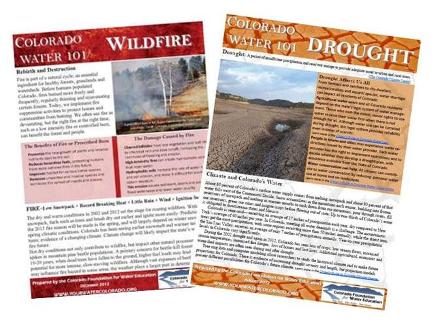
 Water 101 Sheets are one-page references available for download and distribution. Explore the basics of drought, and wildfire or read various water conservation tips through a series of fact sheets. Interested in additional resources? Find them here.
 Climate Workshop
Participants tour the National Ice Core Lab, hear how researchers study climate and what that means locally. Learn more.